
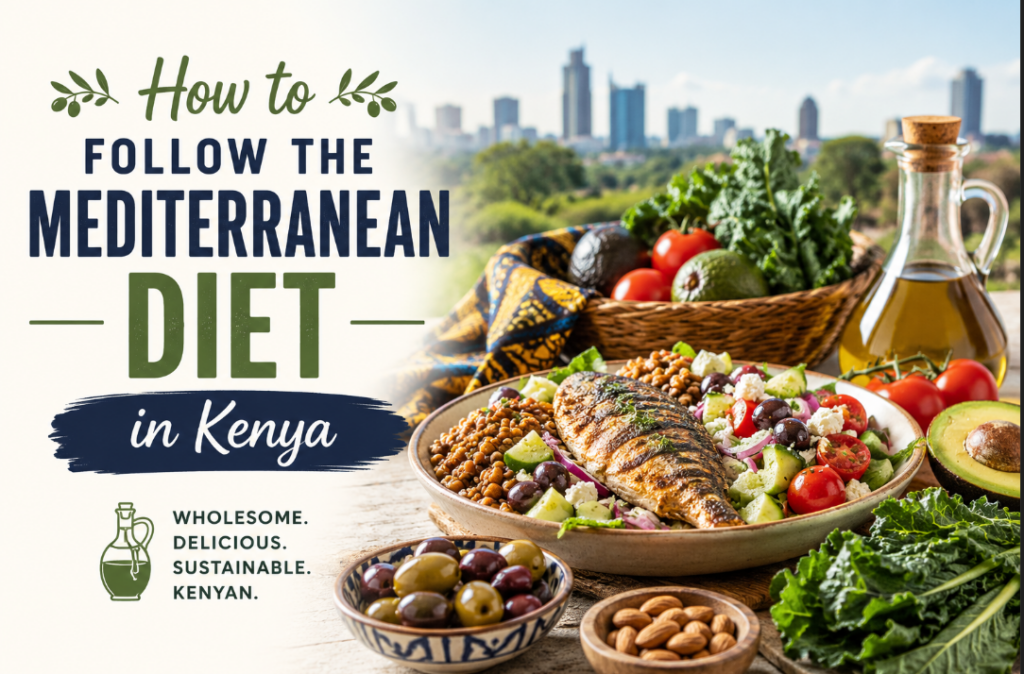

How to Follow the Mediterranean Diet in Kenya
Quick Answer
To follow the Mediterranean diet in Kenya, swap traditional Mediterranean ingredients for local equivalents: use tilapia, omena, or dagaa instead of salmon or sardines; avocado in place of olive oil where possible; sukuma wiki, terere, or managu for leafy greens; ndengu (green grams) and beans as your legumes; and millet or sorghum ugali for whole grains. Eat fish at least twice a week, fill half your plate with vegetables at every meal, and limit red meat to once or twice per week.
What is the Mediterranean diet?
The Mediterranean diet is an eating pattern inspired by the traditional foods of countries bordering the Mediterranean Sea — Greece, Italy, Spain, and Turkey. It is consistently ranked as one of the world’s healthiest diets by nutrition researchers and the World Health Organization.
At its core, the Mediterranean diet is built on five pillars:
- Abundant vegetables and fruits — at least 5 servings daily, ideally 7–10
- Whole grains — whole wheat, oats, barley, and legumes as the carbohydrate base
- Healthy fats — extra virgin olive oil as the primary fat source; nuts and seeds daily
- Fish and seafood — 2–3 times per week for omega-3 fatty acids
- Minimal red meat and processed foods — red meat no more than twice per week; processed foods rarely
Lower heart disease risk
Fish intake per week
Plate should be vegetables
Nuts or seeds daily
Why the Mediterranean diet works in Kenya
Many Kenyans assume the Mediterranean diet is too foreign or expensive to follow locally. In reality, Kenya is exceptionally well-positioned to adopt this eating pattern. The country produces a wide range of fresh vegetables, legumes, fish from Lake Victoria and the coast, avocados, tropical fruits, and traditional grains like millet and sorghum — all of which map naturally onto Mediterranean diet principles.
In fact, many traditional Kenyan meals already share significant overlap with the Mediterranean diet. Githeri (maize and beans) provides protein and fibre much like a Mediterranean legume stew. Sukuma wiki is nutritionally comparable to Mediterranean leafy greens like spinach. Kachumbari — the fresh tomato and onion salad — is structurally identical to a Mediterranean side salad.
The key adjustments are mainly about cooking methods (less frying, more grilling and steaming), portion balance (more vegetables, less ugali), and fat quality (avocado and olive oil instead of cooking fat or margarine).
Kenyan substitutes for Mediterranean foods
This is the most important section for Kenyans starting the Mediterranean diet. Below is a direct substitution guide using foods readily available in Kenyan markets, supermarkets, and local shops.
| Mediterranean food | Kenyan equivalent | Where to find it |
|---|---|---|
| Extra virgin olive oil | Avocado oil or ripe avocado | Supermarkets, health stores; avocado nationwide |
| Salmon / sardines / mackerel | Tilapia, omena (dagaa), Nile perch | Fish markets, supermarkets, Lake Victoria region |
| Spinach / Swiss chard | Sukuma wiki, terere, managu, saga | Every market in Kenya; very affordable |
| Chickpeas / lentils | Ndengu (green grams), red lentils, njahi (black beans) | All markets; inexpensive |
| Whole wheat bread / barley | Millet ugali, sorghum ugali, wimbi porridge | Health stores, supermarkets; unga wa wimbi widely available |
| Walnuts / almonds | Groundnuts (peanuts), cashew nuts, simsim (sesame) | All markets; very affordable |
| Feta cheese / Greek yoghurt | Plain yoghurt (mala / mtindi) | Supermarkets, kiosks nationwide |
| Tomatoes, garlic, onions | Tomatoes, garlic, onions | Identical — in every Kenyan kitchen already |
| Eggplant / zucchini | Biringanya (eggplant), courgettes | Supermarkets, larger markets; coastal areas |
| Red wine (small amounts) | Hibiscus (rosella) tea, fresh passion fruit juice | Markets; dried hibiscus widely sold |
| Fresh herbs (rosemary, basil) | Dhania (coriander), pilipili, lemongrass | All markets; essential in Kenyan cooking |
| Seasonal fruits | Mangoes, passion fruit, papaya, oranges, bananas | Abundant nationwide and affordable |
7-day Mediterranean diet meal plan for Kenya
This meal plan uses ingredients available in Kenyan markets and follows Mediterranean diet principles: high vegetables and legumes, fish 3 times per week, healthy fats daily, and minimal red meat.
Snacks between meals: fresh fruit (mango, banana, passion fruit), a handful of groundnuts or cashews, or plain yoghurt.
Practical tips for following the Mediterranean diet in Kenya
Start with your existing meals
You do not need to overhaul everything. Begin by making small adjustments to what you already eat. Add more sukuma wiki, terere, or managu to every meal. Replace cooking fat (cooking oil or margarine) with avocado oil or a thin spread of ripe avocado. Add a small side salad of kachumbari to lunch and dinner. These small shifts move you meaningfully toward the Mediterranean eating pattern without requiring new recipes or expensive imports. This way, you end up eating healthy at a very small budget.
Cook with less fat, and better fat
Most Kenyan cooking uses deep frying or large amounts of vegetable cooking oil. On the Mediterranean diet, food is primarily grilled, baked, steamed, or lightly sautéed. When oil is used, use a small amount of avocado oil or, if available, extra virgin olive oil. Both are available in Nairobi supermarkets such as Naivas, Quickmart, and Carrefour.
Eat fish at least twice a week
Omega-3 fatty acids from fish are one of the key benefits of the Mediterranean diet. In Kenya, tilapia and omena are inexpensive, widely available, and nutritionally excellent. Omena in particular is one of the most nutrient-dense foods available in East Africa — rich in protein, omega-3s, calcium, and vitamin D. Buy fresh from fish markets, or dried omena from any local market.
Shop at the local market, not the supermarket
The Mediterranean diet is inherently affordable when you shop locally. Sukuma wiki, ndengu, lentils, tomatoes, onions, garlic, groundnuts, and seasonal fruits are among the cheapest foods in any Kenyan market. You do not need imported ingredients. The Mediterranean diet can cost significantly less per day than a processed-food diet when built on local market staples.
Replace refined grains with whole grains
White ugali (unga wa kawaida) is the most common carbohydrate in Kenya, but it has a high glycaemic index and limited nutritional value compared to whole grains. Switch to ugali wa wimbi (finger millet ugali) or sorghum ugali for significantly more fibre, micronutrients, and slower energy release. Both are available in health stores and many supermarkets nationwide. Alternatively, use brown rice or whole wheat chapati.
Reduce sugar and processed foods gradually
The Mediterranean diet sharply limits added sugars, sugary drinks, white bread, biscuits, and processed snacks. Start by eliminating soda and sugary tea, then reduce mandazi and white bread. Replace snacks with fresh fruit, groundnuts, or plain yoghurt. You do not need to be perfect immediately — gradual, sustained change is more effective than extreme short-term restriction.
Foods to limit or avoid on the Mediterranean diet in Kenya
Limit or avoid these foods
- Soda, juice from concentrate, and sugary drinks (Fanta, Coca-Cola, packaged juice)
- Deep-fried foods (mandazi, samosas, chips cooked in excess oil)
- Processed meats (sausages, salami, canned meats)
- White ugali as the dominant carbohydrate at every meal
- Margarine, cooking fat (Kimbo, Rina) — replace with small amounts of avocado oil
- Excess red meat — nyama choma is fine occasionally, not daily
- Highly processed snacks — biscuits, crisps, sweets
- White bread and regular chapati as a daily staple
The Mediterranean diet and sexual health
One of the reasons the Mediterranean diet has attracted growing interest in Kenya is its documented connection to sexual and reproductive health. Research published by the University of South Australia found that the Mediterranean diet’s anti-inflammatory properties can positively affect fertility in both men and women — improving sperm quality, supporting regular ovulation, and reducing conditions that impair conception.
The specific mechanisms are well-studied. Omega-3 fatty acids from tilapia and omena help improve sperm motility and support healthy ovulation. Antioxidants from tomatoes, leafy greens, and fruits reduce oxidative stress that damages reproductive cells. The diet’s effect on blood sugar regulation is particularly important for Kenyan women, as stable insulin levels are crucial for hormonal balance — especially for those with polycystic ovary syndrome (PCOS), which affects a significant proportion of women of reproductive age.
For men, research has found that diets high in processed foods and saturated fat correlate with poor semen quality, while a plant-forward diet rich in whole grains, fish, and vegetables is consistently associated with better sperm parameters. Avocado, groundnuts, and omena — all affordable Kenyan staples — contain zinc, vitamin E, and omega-3 fatty acids, which are among the most researched nutrients for male reproductive health.
For a complete guide to naturally improving sexual health through diet, lifestyle, and evidence-based practices, read our full article:
→ How to Improve Sexual Health Naturally: A Kenya Guide
Ready to improve your health naturally?
Learn how the Mediterranean diet connects to better sexual health, fertility, and hormonal balance in our complete guide.
Frequently asked questions
Can you follow the Mediterranean diet in Kenya on a budget?
Yes — the Mediterranean diet is very affordable in Kenya when you shop at local markets. The most important foods (ndengu, lentils, sukuma wiki, tomatoes, onions, garlic, omena, groundnuts, seasonal fruit) are among the least expensive items at any Kenyan market. Tilapia is cheaper than beef or chicken. You do not need imported olive oil — avocado is a practical and nutritionally excellent substitute.
Is ugali allowed on the Mediterranean diet?
Regular white ugali (unga wa kawaida) is not ideal on the Mediterranean diet because it is a refined grain with a high glycaemic index. However, ugali wa wimbi (finger millet) or sorghum ugali is an excellent fit — both are whole grains with significantly more fibre, minerals, and a lower glycaemic index. Switch to wimbi ugali and keep the portion moderate (no more than one-third of your plate).
Can I eat nyama choma on the Mediterranean diet?
Nyama choma can be part of a Mediterranean-style diet in Kenya, as long as it is consumed occasionally — not daily. The Mediterranean diet allows lean red meat in small amounts, roughly once or twice a week. Choose lean cuts, avoid fatty portions, and always accompany with a large vegetable side such as kachumbari, sukuma wiki, or a fresh salad.
What is the best oil to use for cooking in Kenya on the Mediterranean diet?
Extra virgin olive oil is the traditional choice, and it is available in Kenyan supermarkets. However, locally produced avocado oil is an equally healthy substitute and is more affordable. For everyday cooking, use a small amount of either. Avoid cooking fat (Kimbo, Rina), margarine, and regular refined vegetable cooking oil as the primary fat.
How long does it take to see health benefits from the Mediterranean diet?
Most people notice improvements in energy, digestion, and weight within 4–8 weeks of consistently following the Mediterranean diet. Cardiovascular markers such as blood pressure and cholesterol typically improve within 3 months. Benefits to fertility and hormonal health are generally seen after 3–6 months of sustained dietary change, according to recent research.
Where can I buy olive oil and Mediterranean diet foods in Nairobi?
Extra virgin olive oil is available at Carrefour, Naivas, Quickmart, Chandarana, and health stores such as Zucchini Health Foods. Avocado oil, whole grain flours (wimbi, sorghum), plain yoghurt (mala), and a full range of fresh vegetables and legumes are available at any large supermarket or local open-air market throughout Nairobi and Kenya’s major towns.