
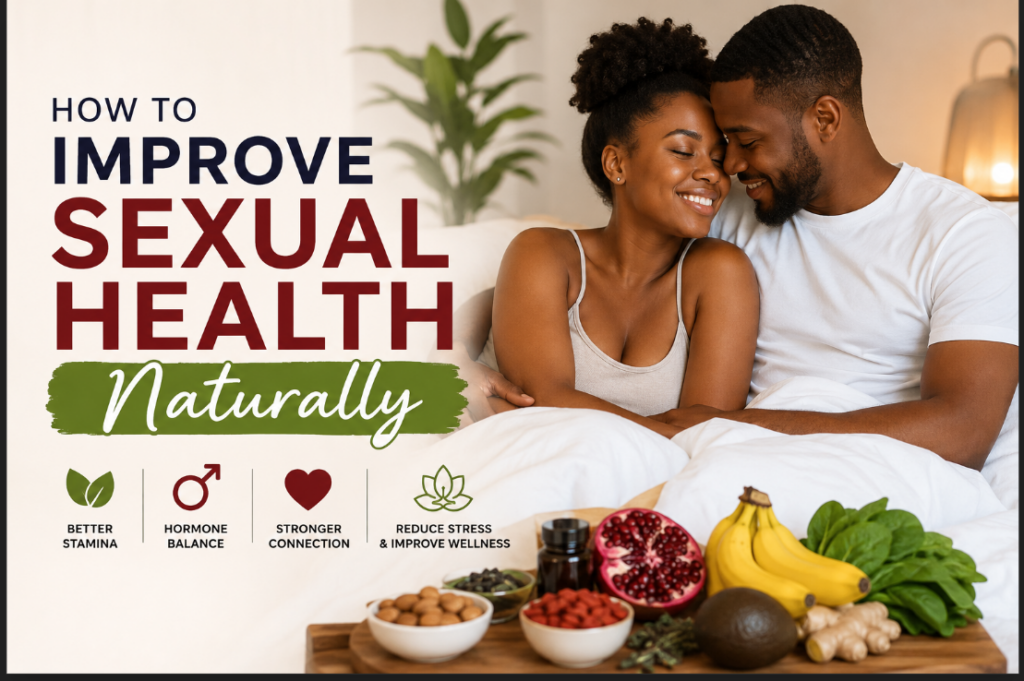

How to improve sex naturally: The Complete Science-Backed Guide
Everything you need to know about sexual wellness — nutrition, exercise, hormonal balance, and emotional intimacy — backed by clinical evidence.
Quick Answer To improve sexual health naturally, focus on these six evidence-based pillars:
Sexual health is not a standalone concern — it is one of the most reliable indicators of your overall physiological wellbeing. Poor cardiovascular health, hormonal imbalance, chronic stress, and nutritional deficits all manifest in diminished sexual function long before other symptoms appear. This guide synthesises the best available clinical evidence into a practical, actionable framework that works whether you are 25 or 65, male or female, in Nairobi or New York.
How to Eat for Sexual Health: Nutrition, Vascular Function and Libido
Sexual arousal and performance depend fundamentally on blood flow — and blood flow depends on what you eat. The endothelium, the thin inner lining of your blood vessels, must be healthy and responsive for adequate genital engorgement and lubrication to occur in both men and women. Poor diet is one of the leading upstream causes of sexual dysfunction worldwide.
The Mediterranean Diet and Sexual Function
The Health Professionals Follow-up Study — one of the largest long-term dietary studies ever conducted — found that high adherence to a Mediterranean-style diet is strongly associated with a significantly reduced risk of erectile dysfunction. The mechanisms are clear: olive oil, avocados, nuts, and oily fish reduce systemic inflammation, improve endothelial responsiveness, and support nitric oxide production, the same molecule that pharmacological drugs like sildenafil target.
Clinical evidence: Men with the highest Mediterranean diet scores in large cohort studies showed up to a 40% lower risk of erectile dysfunction compared to those with the lowest dietary quality scores — without any pharmaceutical intervention.
Fibre, Flavonoids, and Metabolic Control
Dietary fibre — 38g daily for men, 25g for women — plays a critical but often overlooked role in sexual health by preventing type 2 diabetes and dyslipidaemia. Both conditions are well-established precursors to sexual dysfunction: diabetes damages the autonomic nerves and small blood vessels essential for arousal and orgasm, while high LDL cholesterol accelerates the arterial narrowing that reduces genital blood flow.
Flavonoids, found in abundance in berries, citrus fruit, dark chocolate, and leafy greens, further protect vascular integrity. A Harvard study of over 25,000 men found that those with the highest flavonoid intake had a significantly lower incidence of erectile dysfunction than those consuming the least.
Healthy fats
Avocados, olive oil, and nuts. Support endothelial function and reduce arterial inflammation.
Berries and citrus
Rich in flavonoids that protect vascular integrity and reduce oxidative stress in blood vessels.
High-fibre foods
Legumes, whole grains, and vegetables. Prevent metabolic conditions that damage sexual function.
Oily fish
Salmon, mackerel, and sardines provide omega-3s that reduce arterial stiffness and improve circulation.
Exercise and Sexual Performance: What the Research Actually Says
Physical inactivity is one of the most modifiable causes of sexual decline in adults under 50. The cardiovascular system underpins sexual function at every level — from the neural arousal signal to genital engorgement and post-coital recovery — and that system degrades measurably without regular physical challenge.
Cardio Exercise and Erectile Function
Meta-analyses of aerobic exercise trials have produced one of the most cited findings in sexual medicine: 150 minutes of moderate-intensity aerobic exercise per week produces improvements in erectile function scores statistically comparable to those seen with pharmacological intervention. For men with mild-to-moderate erectile dysfunction, supervised aerobic exercise is now considered a first-line recommendation by several urological associations before medication is considered.
Practical target: 30 minutes of brisk walking, cycling, swimming, or jogging, five days per week. You do not need a gym — a morning walk in Karura Forest or an evening run around your neighbourhood qualifies. Consistency matters far more than intensity.
Resistance Training and Hormonal Regulation
Strength training addresses sexual health from a different angle: hormonal regulation and body composition. Muscle tissue is metabolically active — it consumes glucose, reduces insulin resistance, and stimulates testosterone production in a dose-response relationship. Men who engage in regular resistance training for large compound muscle groups (squats, deadlifts, rows, presses) consistently show lower rates of erectile dysfunction and better androgen profiles than sedentary controls of the same age.
For women, resistance training improves body image, reduces cortisol-driven libido suppression, and supports the pelvic floor musculature that contributes directly to sexual sensation and orgasmic response.
- 150 min/week cardio — brisk walking, cycling, swimming, dancing
- 2–3 strength sessions/week — compound lifts targeting large muscle groups
- Pelvic floor exercises (Kegel) — for both men and women; directly improves sexual response
- Reduce sedentary time — prolonged sitting compresses perineal blood flow; stand or walk every hour
- Consistency over intensity — 3 years of moderate exercise outperforms 3 months of intense training followed by burnout
How to Optimise Hormonal Health for Sexual Wellness
Testosterone is the primary driver of libido in both men and women, yet most people do not realise it can be dramatically influenced — upward or downward — by entirely controllable lifestyle factors. Sleep, stress management, and avoidance of endocrine-disrupting chemicals form the hormonal bedrock of sexual health.
Sleep Deprivation and Testosterone: The Critical Link
A landmark University of Chicago study demonstrated that restricting sleep to five hours per night for just one week reduced daytime testosterone levels in young healthy men by 10–15%. This is not a marginal effect — it is equivalent to ageing 10–15 years. Over 80% of testosterone secretion occurs during sleep, concentrated in REM and deep slow-wave sleep cycles. Consistently sleeping fewer than 7 hours disrupts this cycle, with downstream consequences that include reduced libido, impaired erection quality, and reduced arousal in women.
Sleep debt is hormonal debt. Five consecutive nights of poor sleep can produce testosterone reductions comparable to those seen in men a decade older. Before spending money on supplements, optimise your sleep environment: cool room temperature (18–20°C), complete darkness, and a consistent bedtime are the most cost-effective hormonal interventions available.
Endocrine Disruptors: What to Avoid and Why
Phthalates and bisphenol A (BPA) — found in many plastics, food container linings, and non-stick cookware coatings — are classified as endocrine-disrupting compounds. They structurally resemble oestrogen and can bind to hormone receptors, suppressing androgen production at the cellular level. The evidence for their role in reduced testosterone is strongest for chronic, high-level exposure, particularly through heat (microwaving food in plastic containers releases far higher concentrations than cold storage).
- Store and heat food in glass, ceramic, or stainless steel — not plastic
- Avoid canned foods with BPA-lined tins where possible; choose fresh or glass-jarred
- Replace scratched non-stick pans with cast iron or stainless steel cookware
- Manage chronic stress — elevated cortisol directly suppresses testosterone synthesis
- Limit alcohol — more than 14 units per week is associated with measurably reduced testosterone
How to Improve Intimacy: Communication, Anxiety, and Emotional Connection
Performance anxiety is one of the most common — and most treatable — causes of sexual dysfunction, yet it is rarely addressed outside of clinical settings. The anxiety-arousal conflict is physiological: the sympathetic nervous system (the stress response) directly suppresses the parasympathetic activation (rest and digest) that sexual arousal requires. Addressing the psychological dimension of sexual health is not supplementary to the physical pillars above; it is equally important.
Sensate Focus: A Clinically Proven Technique
Sensate focus was developed by Masters and Johnson in the 1960s and remains one of the most rigorously validated sex therapy techniques available. The approach involves shifting the goal of physical intimacy away from performance outcomes (erection, orgasm, penetration) and toward the experience of touch itself — exploring non-genital and erogenous zones with curiosity rather than expectation. Removing the performance goal interrupts the anxiety feedback loop and allows arousal to develop naturally.
Couples who practise structured sensate focus exercises — typically over 4–8 weeks — show significant improvements in sexual satisfaction, desire, and communication, with effects that are sustained at 12-month follow-up in clinical trials.
Communication as a Sexual Health Strategy
A consistent finding across sexual health research is that couples who report high sexual satisfaction also report significantly higher rates of explicit sexual communication than those who report low satisfaction. This includes communication about preferences, boundaries, desires, and feedback during intimacy — conducted outside of sexual encounters when both partners are relaxed and not feeling evaluated.
Practical approach: Schedule a weekly 15-minute conversation about your relationship — not only about sex — without phones or screens. Research on couples who do this consistently shows improved trust, reduced anxiety, and better sexual satisfaction over a 6-month period.
Key Statistics on Sexual Health
of men aged 40–70 experience some degree of erectile dysfunction (Massachusetts Male Aging Study)
of women report sexual dysfunction at some point in their adult lives (NHSLS)
weekly cardio needed to match pharmacological improvement in erectile scores
testosterone drop from just 5 nights of restricted sleep (University of Chicago)
People Also Ask
Frequently Asked Questions About Sexual Health
These questions represent the most commonly searched sexual health topics globally and across East Africa. Each answer is based on current clinical evidence.
The most effective natural interventions are lifestyle-based: adopt a Mediterranean-style diet, perform 150 minutes of moderate aerobic exercise per week, build muscle through compound strength training, sleep 7–8 hours consistently, reduce plastic exposure, and invest in emotional communication with your partner.
These interventions address the root causes of most sexual dysfunction — poor vascular health, hormonal imbalance, and psychological anxiety — rather than symptoms. For most people under 60, sustained lifestyle change produces more durable improvements than short-term pharmaceutical use.
In men, low testosterone typically presents as: chronic fatigue not relieved by rest, persistent brain fog or difficulty concentrating, low mood or depression, reduced physical strength and muscle mass, decreased libido, and erectile dysfunction. Morning erections become less frequent as testosterone levels decline.
In women, low testosterone (which also plays a role in female libido) can manifest as reduced sexual desire, fatigue, mood changes, and decreased muscle tone. These symptoms overlap with many other conditions, which is why a proper diagnosis requires blood work. If symptoms persist despite optimised sleep, diet, and exercise, consult a urologist or endocrinologist for a hormone panel.
Foods that support sexual performance do so primarily through vascular and hormonal mechanisms: avocados (healthy monounsaturated fats for endothelial function), berries and citrus (flavonoids that protect blood vessels), olive oil (anti-inflammatory), oily fish like salmon and mackerel (omega-3s that reduce arterial stiffness), nuts (arginine for nitric oxide production), leafy greens like spinach and kale (nitrate-rich for blood flow), and dark chocolate (flavanols that improve vascular reactivity).
In Kenyan and East African context, many traditional foods are excellent: avocado is widely available and ideal, sukuma wiki (kale) is nitrate-rich, and freshwater fish like tilapia provide valuable protein and omega-3s. A varied, whole-food diet is far more effective than individual “superfood” targeting.
Pornography use is not inherently harmful, but it becomes problematic when it creates unrealistic expectations about body image, stamina, or anatomy — expectations that generate performance anxiety during real-world intimacy. It also becomes a concern when it acts as a compulsive substitute for emotional connection with a partner, reducing real-world sexual desire through dopamine desensitisation.
If pornography use is associated with difficulty achieving arousal with a partner, persistent performance anxiety, or relationship conflict, reducing consumption and replacing it with partner-focused intimacy practices (including sensate focus exercises) is the evidence-based approach. A licensed sex therapist can provide structured support if the pattern persists.
Clinical data consistently show that the vast majority of men who seek enlargement procedures are already within the normal physiological range (erect length of 10–16 cm is considered typical across global studies). Concerns about size are largely driven by unrealistic media and pornography portrayals, not actual partner dissatisfaction.
Research on partner satisfaction shows that technique, emotional connection, duration of foreplay, and communication far outweigh size as predictors of satisfaction. Medical professionals advise strongly against surgical enlargement due to high complication rates, including nerve damage and loss of function. The only method with any documented clinical efficacy for length is penile traction therapy, which requires months of strict adherence and produces modest results.
Testosterone declines at approximately 1–2% per year after age 30 in men, while women experience a more abrupt hormonal shift during perimenopause (typically between 45–55). Both processes are normal, but the speed and severity of functional decline are heavily modulated by lifestyle factors.
Men who maintain consistent aerobic exercise, strength training, adequate sleep, and healthy weight throughout their 40s and 50s demonstrate testosterone levels and sexual function scores comparable to sedentary men a decade younger. For women, hormonal therapy (HRT) is effective for managing menopausal sexual symptoms and should be discussed with a gynaecologist or women’s health specialist — the evidence base for its safety has been substantially updated in the last decade.
Yes — significantly and directly. Chronic psychological stress elevates cortisol, which at sustained levels suppresses gonadotrophin-releasing hormone (GnRH) and, consequently, reduces testosterone and oestrogen production. Anxiety and depression are independently associated with decreased libido, arousal difficulties, delayed orgasm, and sexual avoidance in both men and women.
Treating underlying anxiety or depression — through therapy, medication, or lifestyle intervention — often produces marked improvement in sexual function without any direct sexual health intervention. If you are experiencing persistent mood difficulties alongside sexual health changes, address both concurrently rather than assuming one is primary.
The sexual health supplement industry is largely unregulated and often relies on weak or industry-sponsored evidence. A small number of compounds have reasonable supporting data: L-arginine (a precursor to nitric oxide) at doses above 3g/day has shown modest improvements in erectile function; zinc supplementation benefits men who are genuinely zinc-deficient; ashwagandha has some evidence for stress reduction and modest testosterone support.
However, no supplement approaches the effect size of consistent aerobic exercise, adequate sleep, or dietary improvement. Supplements should be considered only after lifestyle foundations are in place, and ideally under medical guidance — particularly because some interact with medications or have dose-dependent side effects.
Your 30-Day Sexual Health Action Plan
Rather than overhauling everything simultaneously, the most evidence-supported approach is incremental habit stacking — adding one new behaviour per week so each becomes anchored before the next is introduced.
Week 1: Sleep and environment
Set a fixed bedtime and wake time. Remove all screens from the bedroom. Switch plastic food containers for glass or stainless steel.
Week 2: Dietary shift
Add one handful of berries and one portion of leafy greens daily. Replace refined cooking oil with olive oil. Reduce ultra-processed food by 50%.
Week 3: Movement habit
Begin 30-minute daily walks. Add 2 bodyweight strength sessions per week — squats, lunges, push-ups, and rows.
Week 4: Intimacy and communication
Introduce one screen-free evening per week. Begin a weekly relationship check-in conversation. Explore sensate focus if anxiety is present.
When to See a Doctor About Sexual Health
Lifestyle intervention is powerful, but it has limits. Seek medical evaluation if you experience any of the following:
- Erectile dysfunction that persists for more than 3 months despite lifestyle changes — it may signal undiagnosed cardiovascular disease
- Complete loss of libido alongside fatigue, weight gain, and mood changes — this warrants a full hormonal panel
- Pain during intercourse for either partner — this requires gynaecological or urological evaluation
- Any unexplained changes in urinary function alongside sexual symptoms
- Depression or anxiety that is not improving despite lifestyle measures — sexual health and mental health must be treated together
In Kenya: Urologists and sexual health specialists are available at Aga Khan University Hospital, Nairobi Hospital, and Kenyatta National Hospital. You can also access private sexual health clinics and reproductive health NGOs across Nairobi, Mombasa, and Kisumu for confidential consultation.